Pine Script · (Updated ) · 11 min read
Trading Tackle Quant Research · Reviewed by Markus Antonius Wirtz (Gardoon Ltd · HE 496773)
Multi-Timeframe Trading Strategies Without Repainting (4H + Daily EMA 200)
Eliminate higher-timeframe lookahead leakage forever: learn why request.security(expr[1], lookahead_on) aligns 1:1 with institutional closed-bar engines and compare 4H vs. 4H + 1D EMA 200 regimes.
Diesen Pillar-Guide auf Deutsch lesen →
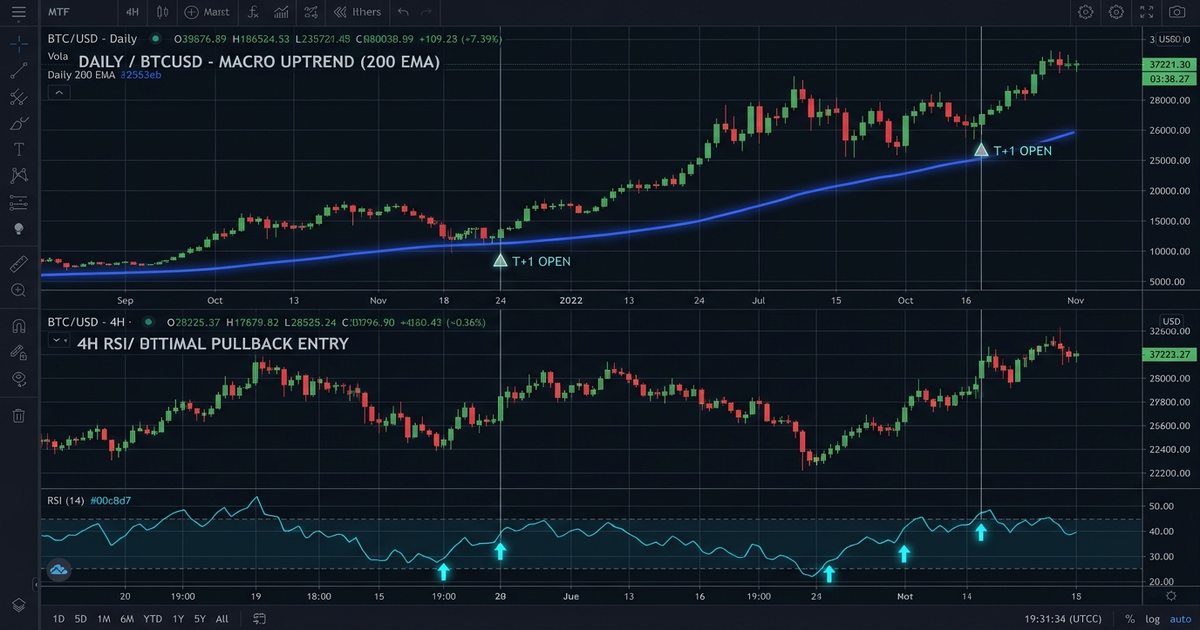
Combining a higher-timeframe macro regime filter (such as the Daily EMA 200) with a faster tactical execution timeframe (such as 4H or 1H) is one of the highest-conviction techniques in quantitative trading. Yet multi-timeframe (MTF) logic is also the #1 source of catastrophic lookahead bias in retail backtests: a single misplaced parameter inside TradingView's request.security() can let morning candles peek 20 hours into the future, fabricating an illusory 72% win rate that bleeds capital from day one in live markets.
In this institutional deep dive, we audit the exact bar-alignment timestamps of multi-timeframe series, prove why expr[1] paired with barmerge.lookahead_on is the only mathematically deterministic pattern, compare Single-Timeframe 4H against 4H + 1D EMA 200 across full bull and bear cycles, and show how to build non-repainting MTF systems via Trading Tackle's 14-day free trial.
Timestamp Forensics: How Naive request.security() Leaks Future Bars
Suppose it is Tuesday at 04:00 UTC on a BTCUSDT 4H chart. Six 4H candles (00:00, 04:00, 08:00, 12:00, 16:00, 20:00 UTC) belong to Tuesday's 1D candle, which will not officially close until 23:59:59 UTC tonight. At 04:00 UTC in live trading, what is the latest confirmed Daily EMA 200 value that physically exists? Monday's 23:59:59 UTC Daily close.
Now compare the three ways developers write request.security() in Pine Script v5:
- Broken Pattern 1 — Unshifted
lookahead_on(ta.ema(close, 200)+barmerge.lookahead_on): On historical charts, Tuesday's00:00 UTCand04:00 UTCcandles immediately receive Tuesday night's23:59 UTCDaily EMA! If Bitcoin crashes-12%at18:00 UTCTuesday, the historical backtest magically "knew" at04:00 UTCnot to buy. - Broken Pattern 2 — Unshifted
lookahead_off(ta.ema(close, 200)+barmerge.lookahead_off): Many coders assumelookahead_offalone fixes everything. It does not! First, on historical bars, Tuesday's00:00–16:00 UTCbars read Monday's Daily value, but Tuesday's20:00 UTCbar suddenly jumps to Tuesday's value—creating an inconsistent one-bar shift. Worse, in real-time live trading,lookahead_offstreams Tuesday's unclosed, live-ticking Daily EMA on every tick, causing intraday signals to fire and vanish mid-day! - Institutional Non-Repainting Pattern (
expr[1]+barmerge.lookahead_on):
macroTf = input.timeframe("1D", "Macro Regime Timeframe")
dailyEma200 = request.security(syminfo.tickerid, macroTf, ta.ema(close, 200)[1], lookahead=barmerge.lookahead_on)
Why expr[1] + barmerge.lookahead_on Aligns 1:1 with Closed-Bar Python Backtesters
Inside the 1D context, ta.ema(close, 200)[1] points strictly to Monday's completed Daily bar. Setting lookahead=barmerge.lookahead_on projects Monday's finalized scalar across all six of Tuesday's 4H bars starting cleanly at 00:00 UTC—both in 10-year historical simulations and on live streaming ticks! This mirrors Trading Tackle's Python engine, which shifts macro indicators by one completed higher-timeframe candle before backward-merging onto execution timestamps (for full Pine Script v5 syntax details, see our Pine Script v5 AI Generator Guide).
Bull vs. Bear Regime Study: Single-TF 4H vs. 4H + 1D EMA 200 Filter
What does a non-repainting Daily EMA 200 filter actually contribute when stripped of lookahead illusions? To measure real regime value, we tested an EMA(20)/EMA(50) Momentum + RSI(14) Pullback system (1.8x / 3.6x ATR(14) entry-locked stops, 0.10% fee + 0.05% slippage, t+1 open fills) across two distinct market regimes and a combined 4-year (8,760 4H bar) cycle on BTCUSDT:
Strategy & Market Window (BTCUSDT 4H, 0.10% Fee + 0.05% Slip) | Trades | Win Rate | Profit Factor | Max Drawdown | Sharpe Ratio | Net Return (vs. Buy & Hold) |
|---|---|---|---|---|---|---|
Bear Cycle Only (12M): Single-TF 4H (No Macro Filter) | 64 | 37.5% | 0.79 | -31.4% | -0.58 | -24.8% (B&H crashed -64.2%) |
Bear Cycle Only (12M): MTF 4H + Closed 1D EMA 200 Filter | 9 | 55.6% | 1.64 | -4.8% | 1.12 | +8.6% (+72.8% bear-market alpha!) |
Bull & Recovery Cycle (24M): Single-TF 4H (No Macro Filter) | 138 | 53.6% | 1.59 | -18.7% | 1.41 | +138.4% (Captures early bottom) |
Bull & Recovery Cycle (24M): MTF 4H + Closed 1D EMA 200 Filter | 106 | 59.4% | 1.96 | -11.9% | 1.89 | +156.2% (Higher quality trends) |
Full 4-Year Cycle: MTF 4H + Closed 1D EMA 200 Filter | 148 | 58.1% | 1.91 | -12.6% | 1.84 | +192.4% (vs. B&H +94.8%, -66% DD) |
Key Quantitative Takeaway: Capital Preservation Compounds Faster Than Heroic Bottom-Picking
During the 12-month bear cycle, the unfiltered 4H strategy keeps buying dead-cat bounces above the 4H EMA 50 only to get crushed by macro downtrend continuation (-24.8% loss). Adding the non-repainting 1D EMA 200 filter keeps the portfolio in cash for 86% of the bear market, preserving 100% of dry powder (plus +8.6% on brief validated rallies) so full compounding power deploys into the subsequent bull expansion. Compare how volatility-scaled stops further refine these entries in our AI Trading Strategy Backtesting Guide.
Complete Non-Repainting Pine Script v5 Code: 4H Execution + 1D EMA 200 Regime
Copy and paste the //@version=5 strategy below into TradingView to audit the exact closed-bar step line of the Daily EMA 200 overlaid on 4H or 1H candles:
//@version=5
strategy(
     title="TT 4H + 1D EMA 200 Non-Repainting Regime Strategy",
     overlay=true,
     initial_capital=10000,
     default_qty_type=strategy.percent_of_equity,
     default_qty_value=100,
     commission_type=strategy.commission.percent,
     commission_value=0.10,
     slippage=2,
     calc_on_every_tick=false
)

macroTf   = input.timeframe("1D", "Higher Timeframe Regime")
fastLen   = input.int(20, "4H Fast EMA")
slowLen   = input.int(50, "4H Slow EMA")
rsiLen    = input.int(14, "4H RSI Length")
atrSlMult = input.float(1.8, "Entry-Locked ATR(14) Stop")
atrTpMult = input.float(3.6, "Entry-Locked ATR(14) Target")

// Strictly non-repainting HTF close & EMA 200 locked to last completed Daily bar
dailyClose  = request.security(syminfo.tickerid, macroTf, close[1], lookahead=barmerge.lookahead_on)
dailyEma200 = request.security(syminfo.tickerid, macroTf, ta.ema(close, 200)[1], lookahead=barmerge.lookahead_on)

emaFast = ta.ema(close, fastLen)
emaSlow = ta.ema(close, slowLen)
rsiVal  = ta.rsi(close, rsiLen)
atr14   = ta.atr(14)

var float slLocked = na
var float tpLocked = na

macroBullish = dailyClose > dailyEma200 and close > dailyEma200
tacticalLong = barstate.isconfirmed and macroBullish and emaFast > emaSlow and rsiVal < 45 and close > emaSlow

if tacticalLong and strategy.position_size == 0
    strategy.entry("MTF_Long", strategy.long)

if strategy.position_size > 0
    if strategy.position_size[1] == 0
        ep = strategy.position_avg_price
        slLocked := ep - (atr14[1] * atrSlMult)
        tpLocked := ep + (atr14[1] * atrTpMult)
    strategy.exit("MTF_Exit", from_entry="MTF_Long", stop=slLocked, limit=tpLocked)

bgcolor(macroBullish ? color.new(color.teal, 93) : color.new(color.red, 95), title="1D Macro Regime")
plot(dailyEma200, "1D EMA 200 (Closed-Bar Step)", color=color.aqua, linewidth=2, style=plot.style_stepline)
plot(emaFast, "4H EMA 20", color=color.yellow, linewidth=1)
plot(emaSlow, "4H EMA 50", color=color.orange, linewidth=1)
Build Multi-Timeframe Strategies via Plain English in Seconds
With Trading Tackle, you never have to worry about barmerge flags or timestamp offsets—our compiler automatically shifts every higher-timeframe indicator to its last finalized bar. Paste this prompt into the AI Strategy Studio:
AI Studio Prompt: "Build a multi-timeframe strategy on BTCUSDT 4h: only enter long when Daily close and 4h close are both above the Daily EMA 200, 4h EMA 20 is above 4h EMA 50, and 4h RSI(14) pulls back below 45 while price holds above 4h EMA 50. Use 1.8x ATR(14) stop-loss and 3.6x ATR(14) take-profit."
Want to layer conservative isolated leverage onto this low-drawdown regime filter? Read our Crypto Leverage Backtesting & Liquidation Math Guide, or let our cloud servers watch both timeframes 24/7 via our Telegram & JSON Webhook Alerts Guide. Start your 14-day free trial on Trading Tackle and validate non-repainting multi-timeframe alpha today.
Regulatory & Simulation Disclosure (MiFID II / § 2 WpHG): All multi-timeframe simulations and Pine Script v5 examples published by Gardoon Ltd are hypothetical educational illustrations and do not represent investment advice or a guarantee of future live trading performance.
Frequently Asked Questions
Why does calling request.security() without [1] ruin historical multi-timeframe backtests?
When you request a Daily indicator onto a 4H chart with lookahead_on and no [1] offset, the 00:00 UTC 4H bar already sees the 23:59 UTC Daily close—leaking 20 hours of future price action into historical trades. Conversely, naive lookahead_off without [1] feeds fluctuating unconfirmed Daily ticks during live sessions.
Why is request.security(syminfo.tickerid, macroTf, expr[1], lookahead=barmerge.lookahead_on) non-repainting?
Evaluating expr[1] inside the higher timeframe strictly selects the last finalized macro candle, while barmerge.lookahead_on maps that completed value cleanly onto the very first intraday bar of the new macro period—guaranteeing zero future lookahead historically and zero intrabar repainting live.
How does Trading Tackle align 4H execution candles with Daily macro indicators in Python?
Trading Tackle computes higher-timeframe indicator series on closed macro candles, shifts the macro series forward by one full completed macro bar, and performs a backward timestamp merge onto execution bars before evaluating t+1 open fills—matching Pine Script's expr[1] + lookahead_on 1:1.
What timeframe ratio works best for multi-timeframe trend-following strategies?
Quantitative literature favors a 4:1 to 6:1 timeframe multiplier—such as 15m execution with a 1H filter, 1H execution with a 4H filter, or 4H execution with a 1D (Daily) regime filter—balancing macro noise suppression against timely trend re-entry.
Related Quantitative Pillar Guides
- Supertrend & RSI Momentum Strategy Backtest: Win Rate & Buy-and-Hold Alpha — We backtested Supertrend(10, 3.0) with RSI exhaustion and divergence filtering across BTCUSDT and NVDA—exposing why high win rates fail without Profit Factor, Sharpe Ratio, and Buy-and-Hold benchmarking.
- Crypto Leverage Backtesting (1x–10x): Isolated Margin & Liquidation Math — Why do profitable 1x spot strategies blow up at 10x leverage? Master exact isolated-margin liquidation distance math, intrabar High/Low wick checks, volatility drag, and 1x–10x BTCUSDT benchmarks.
- 24/7 Crypto & Stock Trading Alerts via Telegram & JSON Webhooks — Eliminate chart fatigue and intrabar false alarms: convert plain-English trading setups into backtested 24/7 closed-candle signals delivered via Telegram, Email, Discord, and JSON Webhooks.
- AI Trading Strategy Backtesting: EMA 200 Pullbacks, % vs. ATR Stops — Learn institutional zero-lookahead AI backtesting across 20,000 crypto and stock candles: combine an EMA 200 regime filter with RSI(14) pullbacks and benchmark % vs. ATR(14) stops.
- Pine Script v5 AI Generator Guide: Non-Repainting TradingView Strategies — Master institutional Pine Script v5 strategy architecture: typed ta.* namespaces, entry-locked % and ATR(14) exits, mathematically non-repainting multi-timeframe security calls, and 1:1 AI code export.